Showing posts with label Word Wall. Show all posts

Monday, September 17, 2012

Word Wall #3

This is our final post about word walls. We would like to share with you some ways in which we use(d) the sight word side of our word wall.

Here are a few games we play to introduce and review these words on a weekly basis.

During the same lesson in which we introduce our sight words for the week, we play a game called Going, Going, Gone. Each student will need their own dry erase board and dry erase marker. (Don't have a class set? They could easily play in partners or small groups) Using the Smartboard write the sight word in disappearing letters. (On your toolbar, it is the icon that has a pen with purple stars around it) The kids have to write the word as many times as they can with correct spelling before the word completely disappears. Once all of the letters have disappeared from the smart board, time is up. Then they get to count how many times they wrote the word- it adds for some excitement.

To review these words, there are two games we play.
The first game is called BANG! You will need to make a card for each of your sight words. For every 10 or so sight words, you will need to add a BANG card.


Have your kids sit in a circle and place all of the cards face down(You will only use the sight words/ that you have currently taught your kids. As the year progressess more cards will be added to the game) Taking turns, each child will pick up a card. If they can read the sight word they get to keep the card. If they miss the word, they get one chance to call on a buddy for help. If the two of them can't correctly read the word, it goes back into the pile. If a student draws a BANG all cards go back into the center. The object of the game is to get back to start without drawing a BANG!

Another game that we play actually incorporates use of the word wall. First, you will need to break your kiddos into two teams. Line them up in front of the word wall (I put small amounts of tape on the floor). The first person in each team will have a flyswatter. You will call out a sight word and they race each other to be the first person to 'swat' the word on the word wall. Remember in post one where we said we alphabetize the words, which means that those words are constantly moving places? This is one of those instances where they need to use those alphabetizing skills in order to find the word they need. Once a team finds the word, the kids pass the flyswatters on to the next two players and they move to the back of the line. Then a new word is given to the two new kiddos at the front of the line. The kids always enjoy keeping score, but that's up to you!

This game can also be played with two different colored flashlights. This time the kids will stay on the line, but they have to be the first to shine their flashlight on the word. (It is very hard to play without colored flashlights, because it is hard to determine which team got to the word first)

Well, we're finally finished with our posts about word walls. We hope that you have enjoyed them and have taken away even just one small idea to use in your classroom. Check back at the end of this week for a sneak peek at our newest TpT unit!



Friday, September 14, 2012

Word Wall # 2

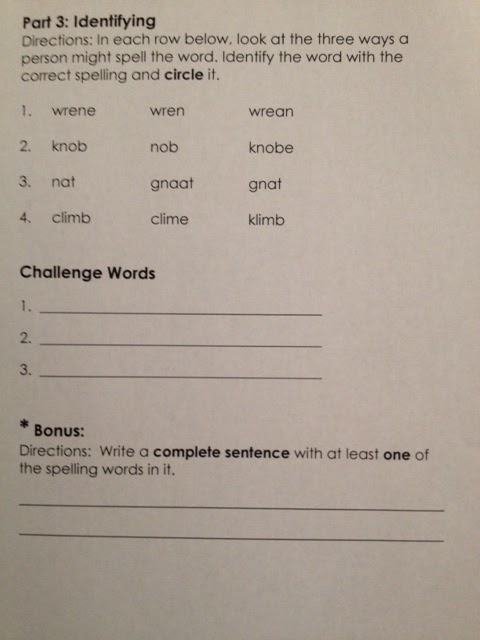
Gone are the days when kids “memorize” words for Friday spelling tests holding the words in short term memory, only to dump them after the test. Rather, students must develop strategies to transfer their spelling rules. The idea is not to overwhelm our kiddos but to get them to identify patterns in words to help them spell similar words. During our second year of teaching we had the privilege of observing an outstanding second grade teacher at a nearby school who was working on creating a spelling unit during her master’s program. We immediately loved the idea of scrapping the traditional spelling tests and adopted these new tests.  Although we don’t use them currently due to our new phonics program Fundations, we still thought we’d share these great assessments with you which completely changed our outlook on spelling.  Each test consisted of three sections: 1) Dictation, 2) Editing, and 3) Identifying.  Below you will find an example.


We were still able to use words similar to our weekly basal rules, we just varied the format. Dictation is exactly what it sounds like (the teacher states 4 words). 
Editing is where students must identify misspelled words in sentences and rewrite them correctly. This helps kiddos during writer’s workshop as well! It really helps them recognize misspellings immediately.
Identifying is where students have to choose the correct word from 3 different choices that look similar. The idea is not to trick kids but to help them to use their decoding strategies.
 
In addition to the regular test, we created a challenge word section where students are to use the rule for the week to spell more difficult words. This is where the word wall really comes in to play. During this time, students can ask us questions about each word in relation to the word wall words such as “Does it have the ing suffix like the word clapping?” or “Does it have the same prefix as the word predict?” They can ask us any questions as well as long as it relates to a word wall word. We never considered this “cheating” like our students claimed.  Instead we referred to this part of the test as using their resources!

Saturday, September 8, 2012

Word Wall #1

This post is going to be the beginning of three posts specifically on word walls. We know you all have them and we have seen them made and used in many different ways. After attending a conference a few years ago, we changed how we used our word wall and have never looked back! Here is the detailed version of how we use our word walls in our classrooms.

We used to do one huge word wall. However, this Pinterest inspired word wall gave us the idea to create two separate ones. Check this out:

Pinned Image

We love how easy this makes it for the little ones to use. Here is how we took this idea and made it ours:


Word Wall 1: sight words/trick words

Word Wall 2: spelling patterns & rules


Now that you have an idea of what they look like, let me explain how they are used. One word wall is for sight words. A few years ago our district decided that we were all going to use Frye's sight words. We broke sight words into three groupings: letters a-h, i-p, q-z. Each grouping of letters gets a different color (see below) and the words are always alphabetized. This makes the kiddos use their alphabetizing skills to find the word they are looking for. At first it takes some getting used to because the words always seem to keep moving around on the wall. However, after they get the hang of how to search, they have no problem finding the words they need to use. Also, when we hold writing conferences, we expect that all sight words will be spelled correctly. If we find one that isn't spelled correctly, it is easy to highlight the misspelled word with the color that matches the group of letters on the word wall. 

For example: If one of my students spelled the word 'use'.... 'uze'.... I would highlight the word in green since 'use' would be green on our word wall (see below) They would then use the word wall to correct it themselves. All I had to do was highlight!


This word wall is from the end of last year. The picture is better so you can see the color-coding as well. 


Last year however, we started implementing a new phonics/spelling program called Foundations. With this program they are given 'trick words'. Trick words are similar to sight words in the sense that they not only need to be able to read them, but spell them correctly. So we switched gears and put our trick words up instead of sight words.
The question we get a lot: "Do you cover up your trick words when it is time to take a spelling test?"
NO!! Believe it or not, but I personally am not a perfect speller ;) I am always using spell check or a dictionary. If I need to use my resources so often why shouldn't my students be able to use their resources as well? I mean, after all, isn't that what we want them to do every other time they get stuck on a word? Now be prepared, during the first few tests I always had someone announce "Hey! The word is right there!" But then they realized I wanted them to look at the word wall to help them spell it correctly. It became less and less amusing with each test we took and eventually they became pretty proficient at using our sight word side of the word wall without making an announcement each time! 

The second word wall is used for spelling patterns and rules. The first year we used the pattern word wall, we used the spelling patterns that accompanied our basal series. Last year we adopted the Foundations program and for each unit our students learn different rules for spelling certain types of rules. We now use these rules on our patterned word wall. (See the picture below)


With the Foundations program, the students also learn to 'mark' the patterns/rules they are learning about. The students can use the word wall to see how to correctly mark their words too.

We have found that the students use this word wall just as much as they do the sight word, word wall. They use this to help them identify word patterns in rules. For example, in second grade we spend a good amount of time discussing different syllable types. If they were struggling spelling the word 'brush', we could tell them it is a closed syllable that has a digraph at the end. They can find the digraph pattern and the closed syllable pattern on our word wall and use it to help them spell the unknown word. In one of our next subsequent posts, we will explain in detail the use of this word wall in relation to a basal spelling program.

It may seem as if this is a lot for those little ones to keep up with. At first, it does take some getting used to. But, we spend time at the beginning of each school year teaching the kiddos how to use each word wall. You would be surprised at how quickly they catch on to each word wall and how efficiently they use it.

Head back at the beginning of the week for another post on our word walls!